The sky over South Australia in the 1950s did not behave the way a sky should. Instead of the familiar, predictable arcs of the sun and the deep, silent stars of the desert night, the horizon fractured. Billowing clouds of black mist and grey ash rolled across the red dirt, carrying with them an invisible poison.
The British military was testing atomic bombs at Maralinga and Emu Field, in the Great Victoria Desert of South Australia. For the Aṉangu people, who had looked after this country for millennia, it was an apocalyptic rupture.
A young Pitjantjatjara and Yankunytjatjara girl named Betty Muffler survived that fallout. Born at Yalungu, a sacred emu site, she witnessed the immediate, devastating displacement of her people and the tragic loss of her close family to the toxic mist. The earth itself was scarred, broken, and left to bleed in the wake of modern warfare.
By all accounts of history, this is where a story of pure tragedy should remain. But Betty Muffler is a ngangkari—a traditional Aboriginal healer. Where there is ash, she chooses to find a way to grow beauty.
"I paint to heal the Country. My country was broken, but through these stories, we make it whole."
The Eagle’s Sightline
To understand Betty’s art, you have to understand how she sees. She doesn’t paint what you see standing on the red dirt, looking out at the horizon. She paints from above.
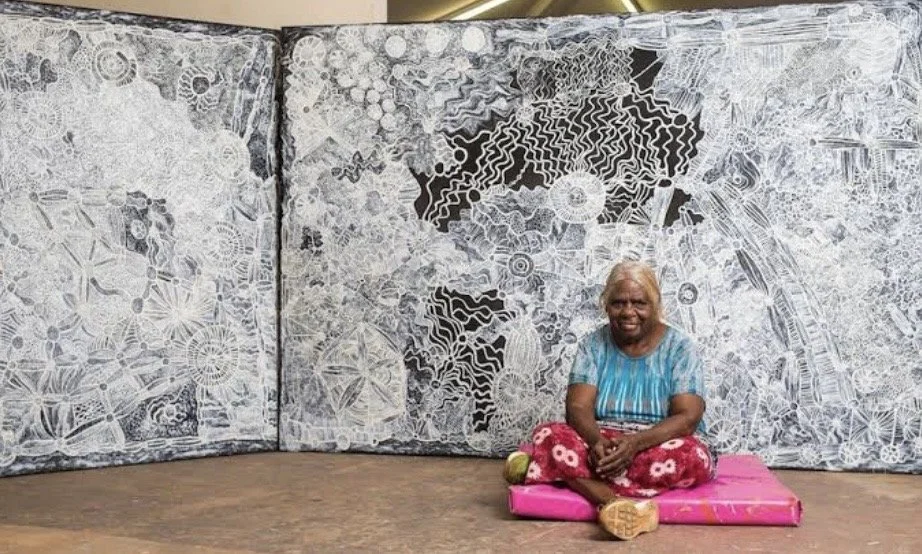
In her ngangkari practice, Betty draws inspiration from the spirit of her father’s ally, the eagle, to ‘fly’ high above the APY Lands. In her highly developed inner world, she looks down to locate lost souls, trace the hidden movement of underground water, and diagnose the pain of the earth. When she sits before a large-scale linen canvas, she is translating that flight.
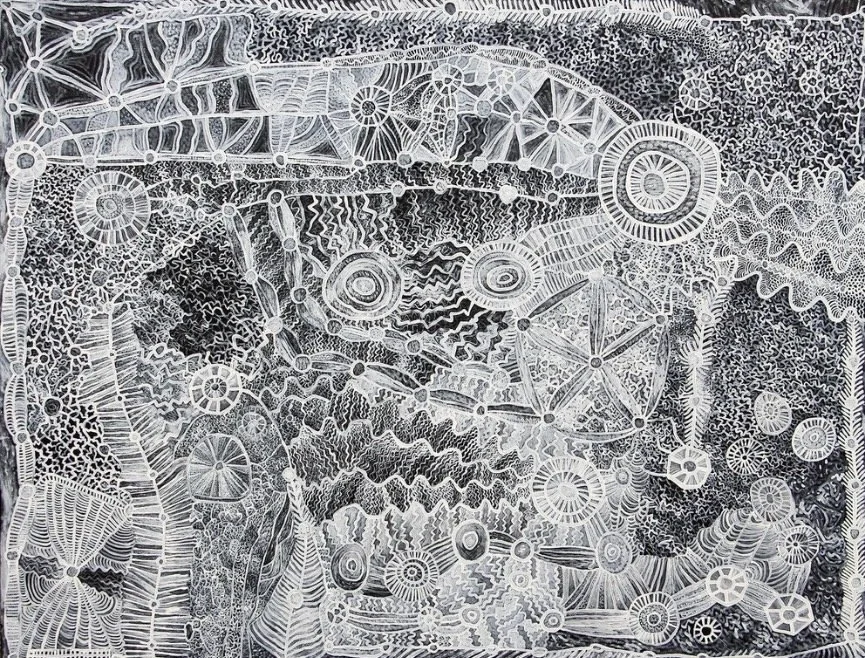
You won't see angry, vengeful marks in her work reflecting the horror she witnessed. Instead, her brush strokes rely on a sophisticated, minimalist palette of soft creams, deep blacks, and monochromatic tones. Looking at her ongoing masterwork series, Ngangkari Ngura (Healing Country), is like looking at the living pulse of the desert. Wavy, fluid lines map out ancient water highways; radiating circles indicate vital rockholes; tiny, intricate details mark the tracks of the emu.
Every stroke is an act of spiritual re-stitching. Where atomic tests left craters and sickness, Betty lays down lines of grace, intentionally embedding "healing hands" into the canvas to soothe the land's historical trauma.
From the Desert to the World Stage
For decades, Betty’s healing work was quiet, intimate, and entirely community-focused. But the power of her visual medicine could not be contained by the desert borders.
In September 2020, as a pandemic-weary world isolated in fear, Vogue Australia did something unprecedented. For their global "Hope" issue, they bypassed fashion models and pop stars, choosing instead to feature Betty’s fine art on the front cover. She made history as the first Australian Aboriginal artist to do so.
The world, desperate for restoration, looked at the undulating white and grey lines of her canvas and felt exactly what Betty intended: a sense of profound peace.
Since then, the accolades have flowed like water through a dry creek bed. From winning major prizes at the Telstra National Aboriginal & Torres Strait Islander Art Awards (NATSIAA) to her massive 2026 solo institutional exhibition at Bundanon, her work has transcended the definition of "art." It has become a global testament to resilience.
The Ultimate Alchemy
Betty Muffler’s life and work remind us of the ultimate creative enchantment: that the most beautiful things we create often come from the places where we were most broken.
She did not let the grey ash of Maralinga define the future of her Country. Instead, she took the memory of that dust, refined it through the lens of a healer, and painted a map of survival for the entire world to see.
Her canvases are a reminder that no matter how toxic the ground beneath us becomes, there is always a way to sing, paint, and dream it back to health.
Source References
Atomic Testing at Maralinga & Emu Field: Her lived experience with the displacement and familial trauma caused by the British nuclear tests in the 1950s is verified by her studio bio at Iwantja Arts and her profiles at the Art Gallery of South Australia (AGSA) and National Gallery of Victoria (NGV).
The Healing Eagle Spirit & Technique: Her practice of painting from an overhead perspective—channeling her father’s spirit eagle to locate lost souls and map topography—is detailed directly by Kiaf SEOUL art curation and documented in a feature by ABC News.
The Historic September 2020 Vogue Cover: The unprecedented assignment of her Ngangkari Ngura (Healing Country) painting to anchor Vogue Australia's historic pandemic-era "Hope" portfolio is recorded by the National Gallery of Australia (NGA) and Vogue Australia's Official Cover Announcement.
Elite NATSIAA Accolades: Her career trajectories—clinching the Emerging Artist Award in 2017 and the prestigious Telstra General Painting Award in 2022—are archived by the Museum and Art Gallery of the Northern Territory (MAGNT) and her commercial gallery profile at Alcaston Gallery.
Major 2026 Solo Exhibition: The details of her first major institutional solo display, Ngangkaṟi Ngura – Healing Country, which launched on 31 October 2026 and runs into early 2027, are sourced via the Bundanon Art Museum Exhibition Space.
Betty Muffler - Ngangkari Ngura (Healing Country) - 152cmx198cm
Synthetic polymer paint on linen