If you caught my last post, you’ll remember I was talking about Richard Lewer’s incredible, Archibald-winning portrait of Iluwanti Ken. But honestly, as amazing as that portrait is, I really wanted to dedicate this post to the woman herself. If you look at the Art Gallery of NSW Archibald finalist details for Richard Lewer's work (nsw.gov.au), it perfectly describes her as a senior Pitjantjatjara Elder and a ngangkaṟi, which means she is a traditional healer. When you look at her art, that immense cultural authority completely radiates through every single line she draws. Her work has this incredible weight and intention behind it, and it almost exclusively focuses on the Eagle Dreaming.
This narrative, known as the Walawuru Tjukurpa, is the sacred creation story that anchors her entire independent art practice. It’s deeply personal, too; it was passed down to her directly through her father’s lineage from the country around Angatja. If you aren't familiar with it, Angatja is a tiny, remote Aboriginal homeland community tucked away in the far northwest corner of South Australia, right within the APY Lands. It’s beautiful, arid outback that stretches out towards the WA and NT borders. It's so protected that you actually need an official permit just to visit.
I’ve spoken before about how mark-making is basically a visual language, almost like an artist's unique handwriting. It evolves over time, expanding its own vocabulary as the artist grows. When you look at Ken’s massive ink drawings and paintings, you can see this beautiful example of "the medium is the message." The story unfolds through layers and layers of extensive, deliberate marks.
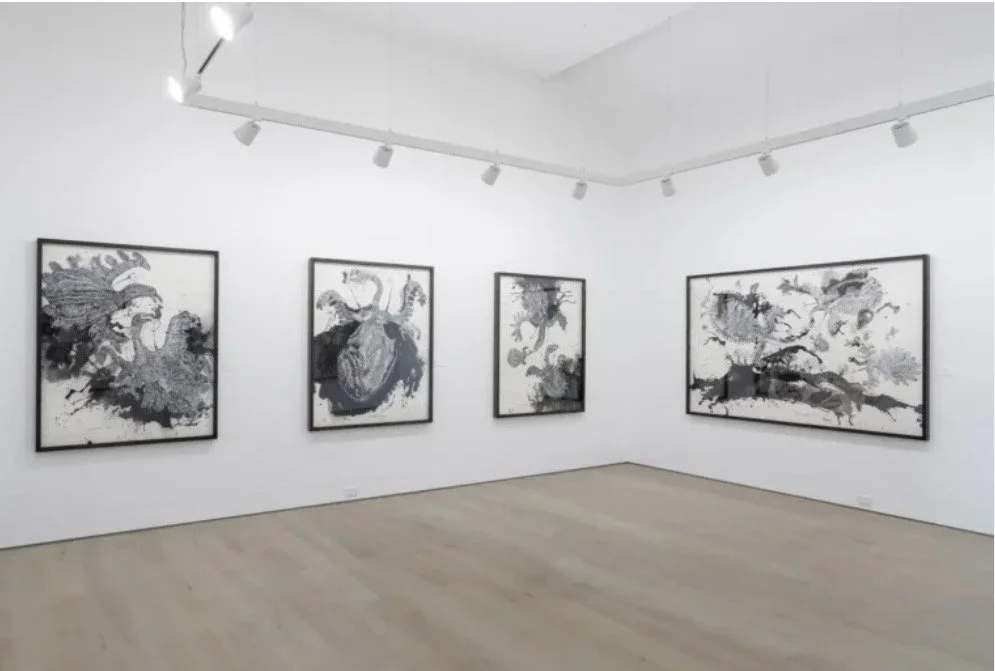
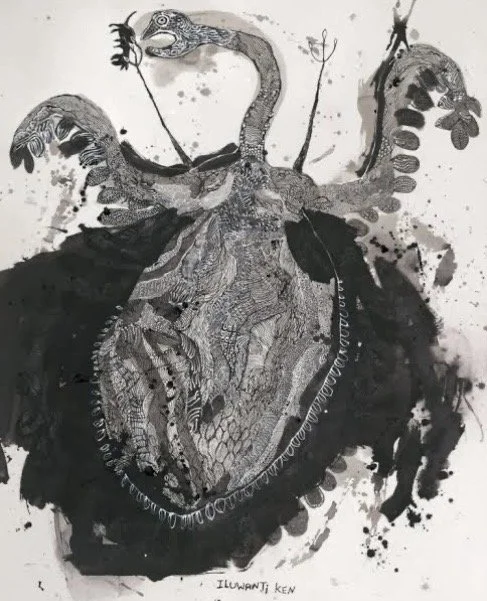
For Ken, the eagle is the ultimate symbol of maternal power. Her stories focus deeply on themes of motherhood, protection, and fierce care. In fact, a title she uses a lot is Walawuru ngunytju kukaku ananyi, which translates to "Mother eagles going hunting." She paints these massive wedge-tailed eagles that rule the desert skies, capturing them as they fly out across the arid landscape to find meat to feed and protect their chicks back home. Major institutions have completely fallen in love with this series, for instance, you can view her monumental 2023 canvas of Walawuru ngunytju kukaku ananyi at the National Gallery of Victoria (ngv.vic.gov.au), and she even took a stunning 2020 iteration to the Art Gallery of South Australia via the Tarnanthi Festival (agsa.sa.gov.au).
You can actually see how the physical architecture of the eagles' environment completely dictates the layout of her canvases. She usually builds her compositions around these large, dense circular shapes that represent the eagle's nest, or itjanu. Then, branching out from those nests, she paints these intricate, sweeping networks of lines. They trace the paths of the eagles soaring high above, hunting for food, effectively mapping out the rugged topography of the Mann Ranges. I love looking at her work because it feels like an ancestral map of matriarchal strength, survival, and Country. In her artist notes for the Sir John Sulman Prize (nsw.gov.au), she beautifully captures this spirit, explaining that even when the eagle is laser-focused mid-hunt, she is thinking only of the family waiting at home. When I look at her work, I can so easily picture her staring into that vast desert sky, completely comfortable with the stillness, just translating a lifetime of cultivated visual language onto the canvas.
What makes her visual style so fascinating is how much it departs from the traditional dot painting we usually see from the Western Desert. She doesn't use standard paintbrushes. Instead, she uses punu, which are wooden carving sticks, dipped in heavy ink or synthetic polymer.
The result is this raw, vibrating texture made of thick, overlapping, cross-hatched lines that perfectly mimic the heavy feathers of the eagles and the tangled twigs of their massive nests. And here is my absolute favorite detail: if the tip of her stick is too fine to make the specific mark she wants, she will actually chew on the end of the wood to fray the fibers. By making the tip furry and uneven, the ink absorbs and releases onto the canvas in a beautifully unpredictable way, mimicking the natural imperfections you find in the wild. She layers black and white ink using those scratchy marks to build up the bodies of these powerful birds. It creates this stunning optical vibration on the canvas, giving the feathers a real sense of physical weight and movement. It is just spectacular to look at.
The ‘Walawuru ngunytju kukaku ananyi ‘is an ongoing series of distinct, individual artworks created by Ken. The title serves as a thematic umbrella for a large body of work produced over several years. When you see different images under this name, you are looking at unique iterations of the same sacred ancestral story. While every drawing is unique, they are all a visual map of her eagle dreaming, the mother eagle hunting, building strong shelters protecting her chicks , metaphorical for Anangu motherhood and family care. (Art gallery of NSW).
Walawuru ngunytju kukaku ananyi by Iluwanti Ken: