I have found myself returning to the work of senior Aṉangu women from the APY Lands, Anangu meaning ‘people’ or ‘human being’ in Western Aboriginal languages.
First Illuwanti Ken whose intricate mark-making feels like a direct pulse from the earth.
Then Betty Muffler with her quiet, meditative monochromes. Naturally, that journey has led me to Betty Kuntiwa Pumani.
Like Ken and Muffler, Pumani is both a senior artist and a respected ngangkaṟi (a traditional healer). In her community of Mimili, she works to restore spiritual balance and remove pain. In her studio at Mimili Maku Arts, that same restorative intention translates directly onto the linen, through an explosion of radiant light, memory, and colour. (Mimili: The Pitjantjajara name for the community situated at the base of the Everard Ranges.
Painting Antaṟa: A Home, tracing family decent and lineage from the mother’s side of the family
When we paint a place we love, we are rarely just recording what our eyes see. We are painting layers of memory, belonging, and the people who shaped our relationship to that ground.
For Betty Pumani, home is Antaṟa, a major sacred site on her mother’s Country, a vast expanse of rounded granite hills, red desert earth, and freshwater rockholes in South Australia. Every canvas she creates is an act of custodianship for this sacred landscape and its Maku Tjukurpa , Witchetty Grub Dreaming, rich are major creation stories. (Maku: The word for the witchetty grub -ma traditional bush food)
What moves me deeply about Pumani’s practice is how fiercely intergenerational it is. She learned to paint by watching her mother, the founding Mimili Maku artist Kunmanara (Milatjari) Pumani, and her late sister, Kunmanara (Ngupulya) Pumani. After their passing, Betty stepped forward to carry those stories, and today, she continues the cycle by painting collaboratively alongside her daughter, Marina Pumani Brown. Her canvases are living archives of women holding space for one another across generations.
The Patience of the Stick (Punu)
As artists, we often talk about letting the process dictate the pace of a piece. Pumani takes patience and tactile connection to an extraordinary level.
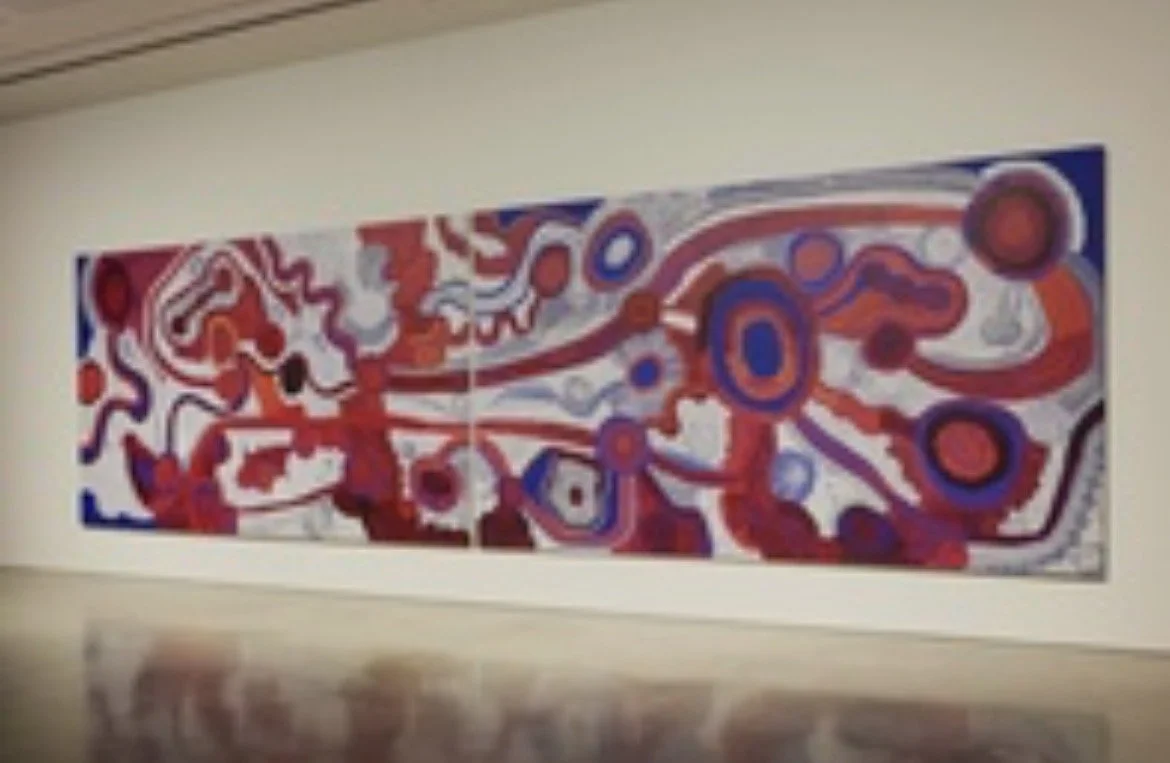
She paints with a single wooden stick (punu). Even when confronting a monumental scale such as her breathtaking 3 x 10 metre diptych Antara for the Museum of Contemporary Art Australia, she spent five months applying every single dot, dash, and stipple with that one stick.
There is a profound lesson in that kind of devotion. When you build a surface mark by mark, layer by layer, there is no rushing the outcome. You have to stay entirely present with the surface in front of you.
Colour as Vitality and Healing
If Betty Muffler’s monochrome paintings feel like a quiet breath after a storm, Betty Kuntiwa Pumani’s paintings feel like the desert bursting into life the morning after rain.
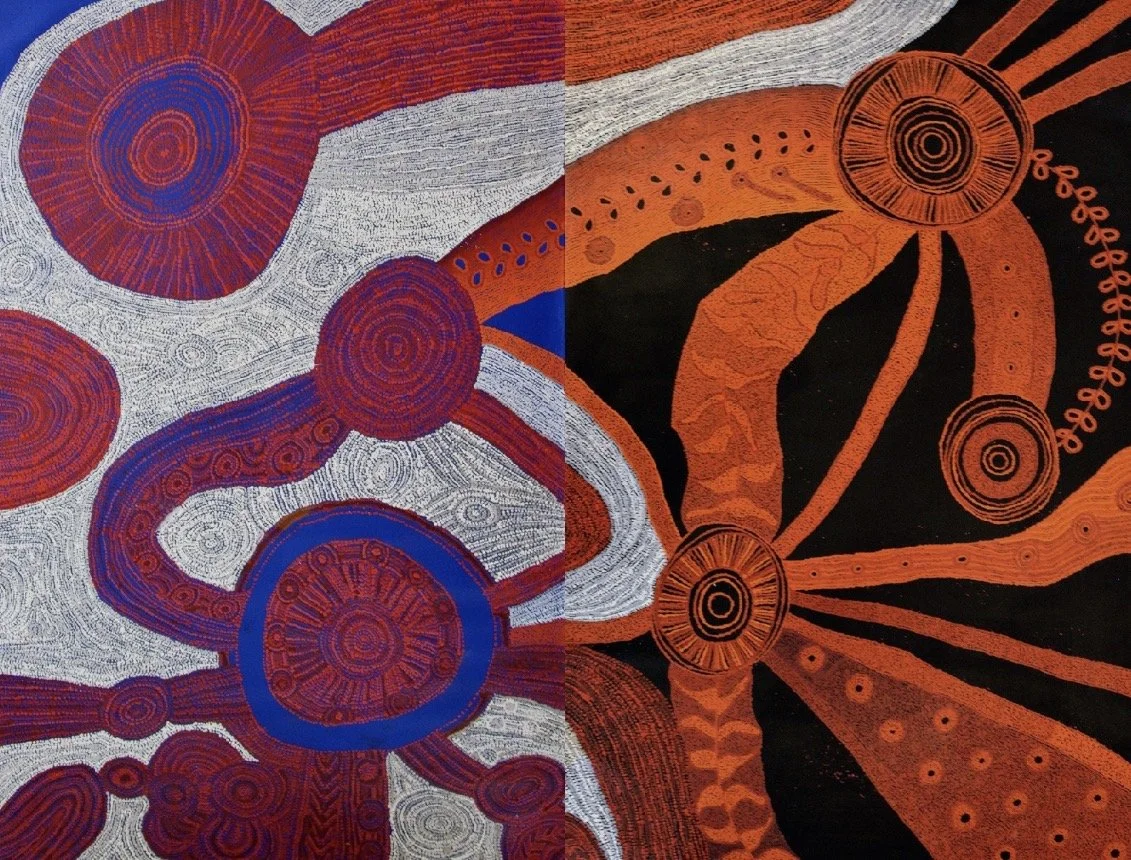
In her Wynne Prize-winning work Antara (2017) and across her major survey exhibition maḻatja-maḻatja (those who come after), Pumani pairs rich, saturated earth reds with electric cobalt blues and luminous fields of white stippling. Those delicate white dots represent mingkulpa, native tobacco flowers blooming across the hills after water returns to the land.
Looking at her work, you can feel the physical and spiritual relief of rain hitting dry ground. Her palette is a visual manifestation of a healthy, thriving landscape. As a healer, she understands that when Country is cared for and remembered, the people connected to it are healed too.
What I’m Taking Back to the Studio
Spending time with Betty Kuntiwa Pumani’s work reminds me that art doesn't have to shout to hold immense power, yet it shouldn't shy away from vibrancy either. It has left me thinking about three things in my own practice:
Honouring the tools: How the simplest, most direct implements, a stick, a raw edge, a bare hand, often carry the most honest energy onto a canvas.
Layering memory: Treating a painting not as a single snapshot, but as a slow accumulation of lived experience, gratitude, and quiet persistence.
Painting as care: Remembering that the act of making is at its heart, a way of tending to our inner landscapes and sharing that peace with whoever stands in front of the work.
References:
Mimili Maku Arts – Artist Profile: Betty Kuntiwa Pumani, sharing her connection to her mother’s Country, Antaṟa, and the collaborative family traditions at her home art centre.
Museum of Contemporary Art Australia (MCA) – Betty Kuntiwa Pumani: Home and Family, an insightful look into her five-month process painting her monumental Antara diptych using a single wooden stick (punu).
Art Gallery of New South Wales – Antara (2017), collection notes detailing her Wynne Prize-winning work and the meaning behind the blooming mingkulpa (native tobacco) flowers.
Bundanon Art Museum – Betty Kuntiwa Pumani: maḻatja-maḻatja (those who come after), exhibition notes celebrating her career survey and intergenerational knowledge sharing.
Betty Kuntiwa Pumani
Title: Antara (2020)
Size: 300×1000 ea
Medium: Synthetic Polymer paint on linen