I’ve been thinking again about Cy Twombly and how his work has quietly influenced me over the years.
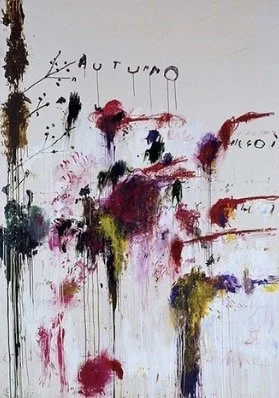
Before fully becoming the artist we know, Twombly spent time in the U.S. Army working as a cryptologist. It’s hard not to feel that this left a trace in his work. His paintings often read like a kind of coded language, thin, searching lines scratched across darker grounds, drips and splatters, pencil marks that move restlessly across the surface. There’s a sense of something being written and erased at the same time.
What draws me most at the moment, though, are his floral works from the mid-1970s.
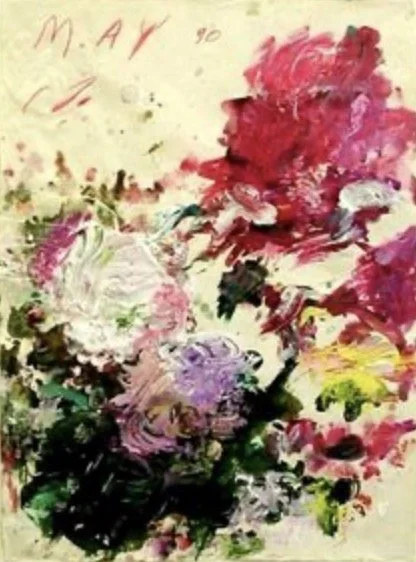
These are not flowers in the traditional still-life sense. They don’t sit politely in a vase waiting to be observed. They feel as though they belong to the land, to a garden, or even to memory itself. They are less about describing a flower and more about evoking the feeling of one.
Twombly’s work can be understood as a kind of ongoing engagement with what we might call cultural memory, the way we carry the past forward through images, symbols, stories and gestures. It’s not really about facts. It’s about meaning. About how things are remembered, softened, reshaped, and felt over time.
For him, painting seems to have been a kind of fusing process. A bringing together of ideas and feelings. Landscape, colour, fragments of writing, and collage elements all come together on the surface. He often drew from literature and myth, Leda and the Swan, The Birth of Venus, using fragments and references that feel almost like clues. Over time, these marks, loops, scratches, numbers, erasures begin to form their own kind of language.
And then there are the flowers.
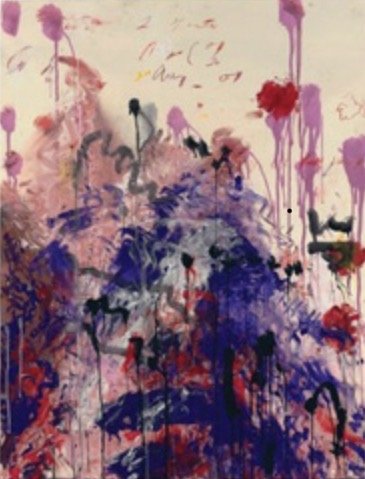
In his later work, they become something quite lush and expansive. A shift away from the tighter, darker “blackboard” paintings into something more open, saturated, and immersive. Roses, peonies, tulips rendered in sweeping gestures of paint, often dripping, sometimes barely held together. They feel alive, but also fleeting.
There’s a sense of beauty, but also of time passing. Of something blooming and dissolving all at once.
I find myself returning to these works because they sit in that space I’m so interested in between observation and feeling. Between the physical world and something less tangible. They remind me that a painting doesn’t need to describe a thing in order to hold it. Sometimes it’s enough to evoke it, to let it surface slowly through marks, through colour, through gesture.
Perhaps that’s what stays with me most. The idea that painting can become its own language—one that doesn’t explain, but quietly remembers.